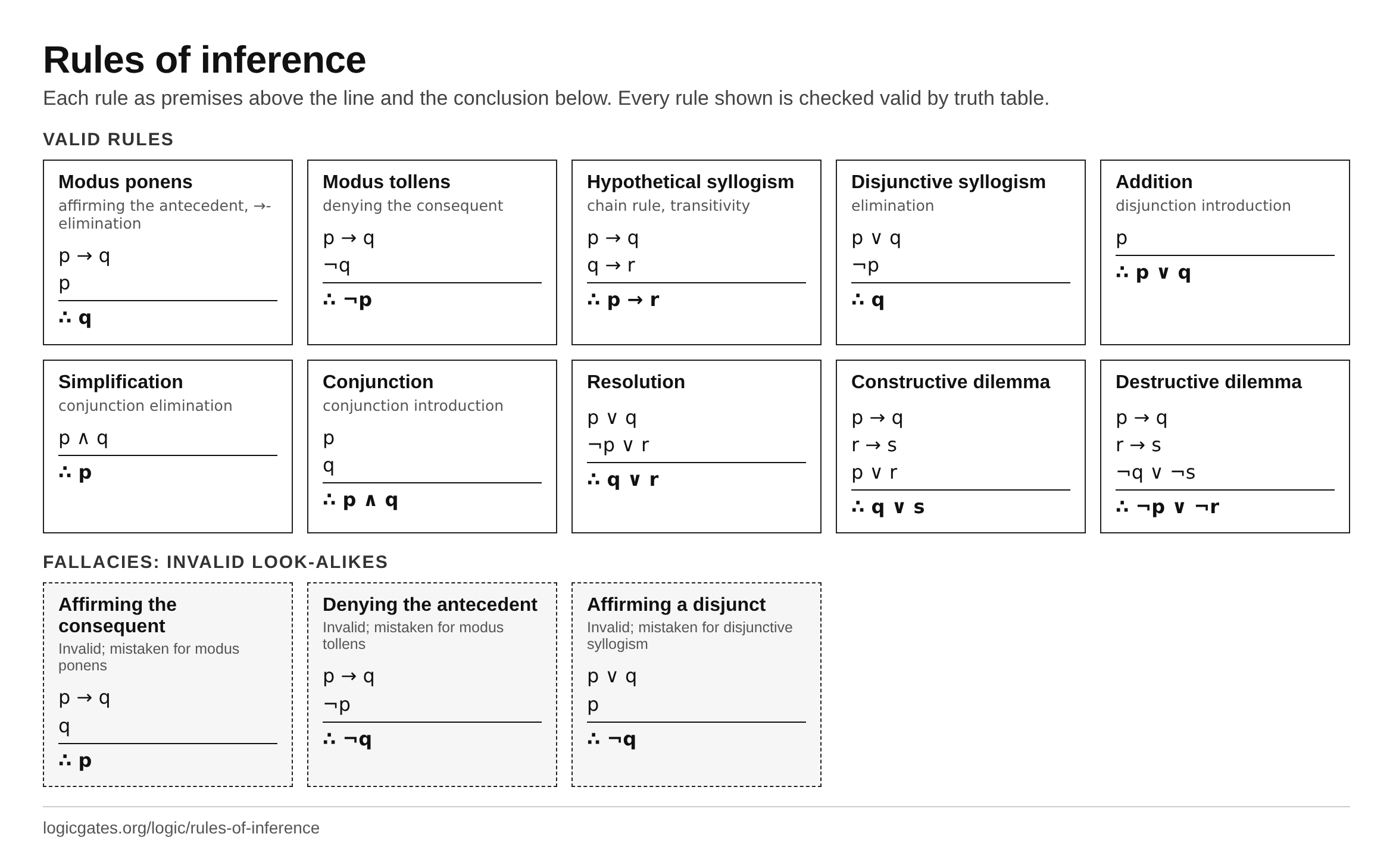
The valid patterns of reasoning that proofs are built from, each with its form, an everyday example and a truth
table check, followed by the fallacies that look like them and a proof written step by step.
Arguments, validity and rules
An argument is a list of statements, the premises, followed by a
conclusion, marked with ∴ ("therefore"). It is valid when the conclusion is true
in every case where all the premises are true. Validity is about form, not content: replace the letters with any statements
you like and a valid form stays valid.
A rule of inference is a short valid form that is worth a name. Each one below was checked by
listing every row of its truth table when this page was built. Written as a single statement, each is also a
tautology: modus ponens becomes
(p → q) ∧ p → q, true in every row.
A formal fallacy is an argument form that looks like a rule but is not valid: some row makes every premise true
and the conclusion false. One such row, a counterexample, is enough to sink it.
Affirming the consequent
Often mistaken for modus ponens
p → q
q
∴ p
If it rained, the grass is wet.
The grass is wet.
Therefore, it rained.
The grass could be wet from a sprinkler: q can be true for reasons other than p.
A truth table can check any argument, but it doubles in size with every letter. A proof reaches
the conclusion in a few lines instead: list the premises, then add one line at a time, each following from earlier
lines by a rule of inference or by replacing part of a line with something
logically equivalent. The proof ends when the conclusion appears.
Take this argument:
The train is running or I take the bus.
It is snowing and the train is not running.
If I take the bus, I am late.
If I am late, I call ahead.
Therefore, I call ahead, and it is snowing.
t: the train is running;
b: I take the bus;
s: it is snowing;
l: I am late;
c: I call ahead.
Line
Statement
Justification
1
t ∨ b
Premise
2
s ∧ ¬t
Premise
3
b → l
Premise
4
l → c
Premise
5
¬t ∧ s
Commutative law, 2
6
¬t
Simplification, 5
7
b
Disjunctive syllogism, 1, 6
8
b → c
Hypothetical syllogism, 3, 4
9
c
Modus ponens, 8, 7
10
s
Simplification, 2
11
c ∧ s
Conjunction, 9, 10
Line 11 is the conclusion, so the argument is valid. Every step was checked when this page was built:
the lines it cites entail it, and it has the exact shape of the rule it names. Line 5 uses the commutative law to
swap the sides of ∧, since simplification here keeps the left part.
The full truth table agrees, over all
32 rows.
Some habits that make proofs easier to find:
Break conjunctions apart with simplification early; single letters are easier to use.
Look for a conditional whose antecedent you have (modus ponens) or whose consequent you can deny (modus
tollens).
Chain conditionals with hypothetical syllogism before applying them.
Work backwards from the conclusion: ask which rule could produce it, and what that rule needs.
Rewrite with equivalences when a line is in the wrong shape, for example p → q as
¬q → ¬p (the
contrapositive).
Resolution and computers
Resolution deserves a word of its own. Rewrite every premise and the negation of the conclusion as ORs of letters
and negated letters (conjunctive normal form), then
resolve pairs of clauses until the empty clause, a contradiction, appears. That one rule is complete for proving
that a set of clauses is unsatisfiable, which is why it, and descendants of it, run inside theorem provers and the
SAT solvers used to verify chips.
Questions
What are rules of inference?
Rules of inference are valid argument forms: patterns such as "p → q and p, therefore q" whose conclusion is true whenever all the premises are true, whatever statements the letters stand for. A proof is a chain of steps, each justified by one of these rules applied to earlier lines.
What is the difference between modus ponens and modus tollens?
Both start from a conditional p → q. Modus ponens adds p and concludes q: it affirms the antecedent. Modus tollens adds ¬q and concludes ¬p: it denies the consequent. They are the two valid ways to use a conditional; the two mirror images, affirming the consequent and denying the antecedent, are fallacies.
What does modus ponens mean?
Modus ponens is Latin for "the way that affirms", short for modus ponendo ponens, "the way that affirms by affirming". Modus tollens is "the way that denies", from modus tollendo tollens. The names describe what the second premise does to the conditional.
How do you know a rule of inference is valid?
Check its truth table: in every row where all the premises are true, the conclusion must be true too. Equivalently, (premises joined with ∧) → conclusion must be a tautology. Every rule on this page was checked that way when the page was built, and the calculator will check any argument you type.
What is the difference between a rule of inference and a logical equivalence?
A rule of inference works in one direction on whole lines: from p ∧ q you may infer p, but not the reverse. A logical equivalence works in both directions and may replace any part of a statement, because both sides always have the same truth value. Proofs use both.
Is a valid argument always true?
No. Validity is about form: if the premises are true, the conclusion must be. "If the moon is cheese, it is edible; the moon is cheese; so it is edible" is valid modus ponens with a false premise. An argument that is valid and has true premises is called sound, and its conclusion is true.