NOR gate
High only when every input is low.
Truth table
| a | b | Q |
|---|---|---|
| 0 | 0 | 1 |
| 0 | 1 | 0 |
| 1 | 0 | 0 |
| 1 | 1 | 0 |
At a glance
- Boolean expression
- ¬(a ∨ b)
- Engineering notation
- (a + b)'
- Inputs
- Two or more
- Output is high when
- every input is low
How the NOR gate behaves
A NOR gate outputs 1 only when all of its inputs are 0. Any input going high drops the output to 0. It is an OR gate with the output inverted.
Like NAND, NOR is functionally complete, so it can build every other gate on its own. It is also the gate behind the classic SR latch: two NOR gates each feeding the other's input, which is the first circuit most people meet that has memory rather than just combinational behaviour.
Building it from other gates
Each of these is equivalent to the NOR gate. Paste any of them into the simulator with ctrl+E to see the circuit.
| Construction | Expression | Equals |
|---|---|---|
| NOT from NOR | !(a | a) | !a |
| OR from NOR | !(!(a | b) | !(a | b)) | a | b |
| AND from NOR | !(!(a | a) | !(b | b)) | a & b |
| De Morgan form | !a & !b | !(a | b) |
Reference card
The symbol in both standards and the truth table on one image, for notes or a slide.
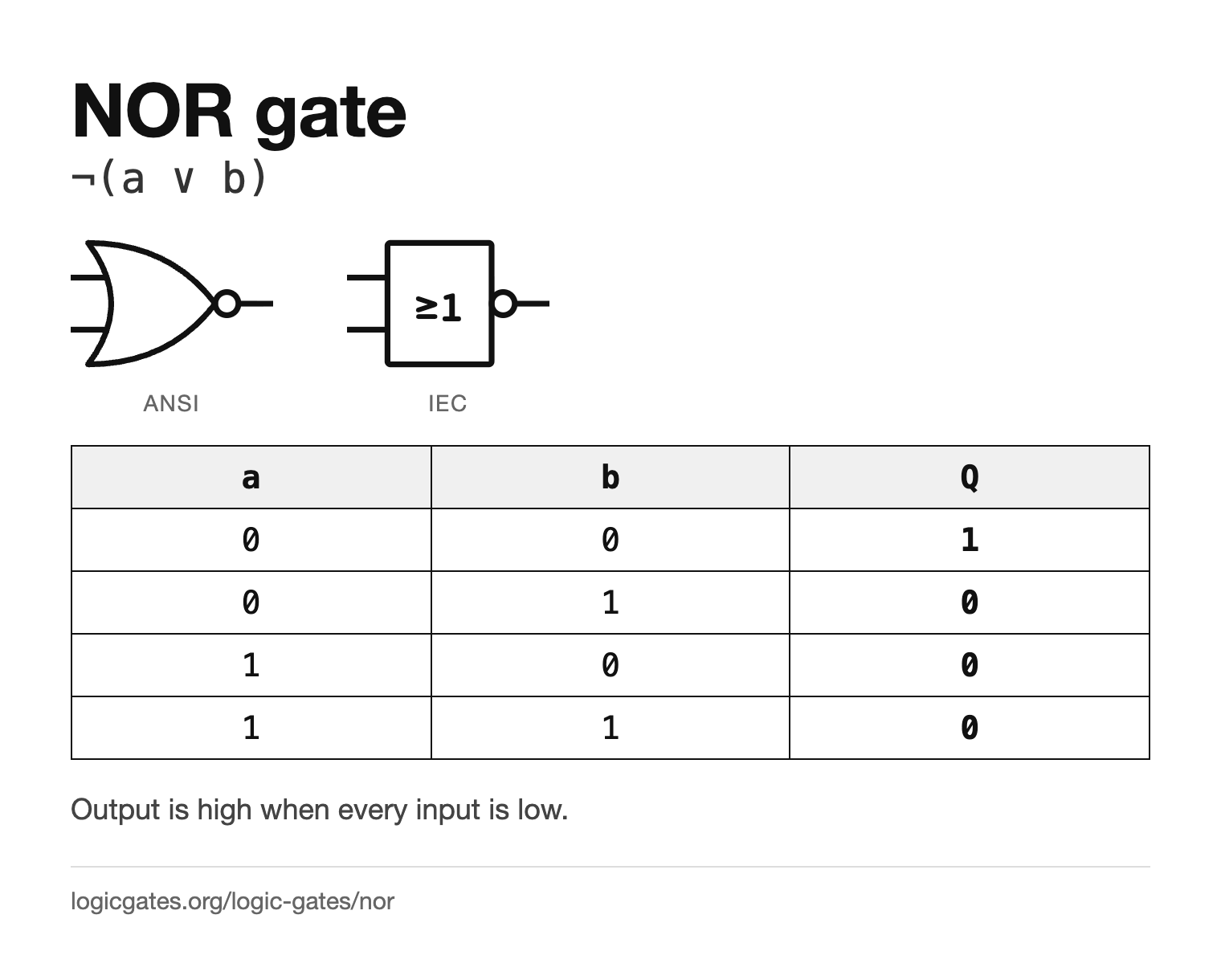 Click to download the NOR reference card
Where the NOR gate is used
- Cross-coupled pairs form an SR latch, the building block of flip-flops and registers.
- Detecting that a bus or a set of flags is completely idle, since NOR is high only when everything is low.
- Building any other gate, in the same way NAND can.
- The Apollo Guidance Computer was famously built almost entirely from three input NOR gates.
In the simulator
NOR is in the Logic menu with a configurable input count. Wire two of them into each other, output to input, and you have a latch you can set and reset.
Questions about the NOR gate
How do you build an SR latch from NOR gates?
Take two NOR gates and feed each gate's output into one input of the other. The remaining free inputs become set and reset. Raising set drives one output high and it stays there after set returns low, which is what makes it a memory element.
What is the difference between NOR and NAND?
NOR outputs 1 only when all inputs are 0; NAND outputs 0 only when all inputs are 1. So NOR is 1 on just one of its four rows and NAND on three. Invert every input and the output of a NAND and you get a NOR, which is De Morgan's law in gate form. Both are universal.
Is NOR or NAND better for building everything?
Both are universal, so either works. In practice NAND is preferred in CMOS because it is slightly faster and smaller for the same drive strength, but NOR-only designs have been built, most famously the Apollo Guidance Computer.