NOT gate
Outputs the opposite of its single input.
Truth table
| a | Q |
|---|---|
| 0 | 1 |
| 1 | 0 |
At a glance
- Boolean expression
- ¬a
- Engineering notation
- a'
- Inputs
- One
- Output is high when
- its single input is low
How the NOT gate behaves
A NOT gate, also called an inverter, has one input and one output. It turns 1 into 0 and 0 into 1. Inverting twice gets you back where you started, which is the double negation law.
It is the only gate that does not combine anything. Everything else on this page merges two or more signals; the inverter just flips one. That makes it the piece that turns AND into NAND, OR into NOR, and a positive condition into a negative one.
Building it from other gates
Each of these is equivalent to the NOT gate. Paste any of them into the simulator with ctrl+E to see the circuit.
| Construction | Expression | Equals |
|---|---|---|
| From a NAND gate | !(a & a) | !a |
| From a NOR gate | !(a | a) | !a |
| From XOR with a 1 | a ^ 1 | !a |
Reference card
The symbol in both standards and the truth table on one image, for notes or a slide.
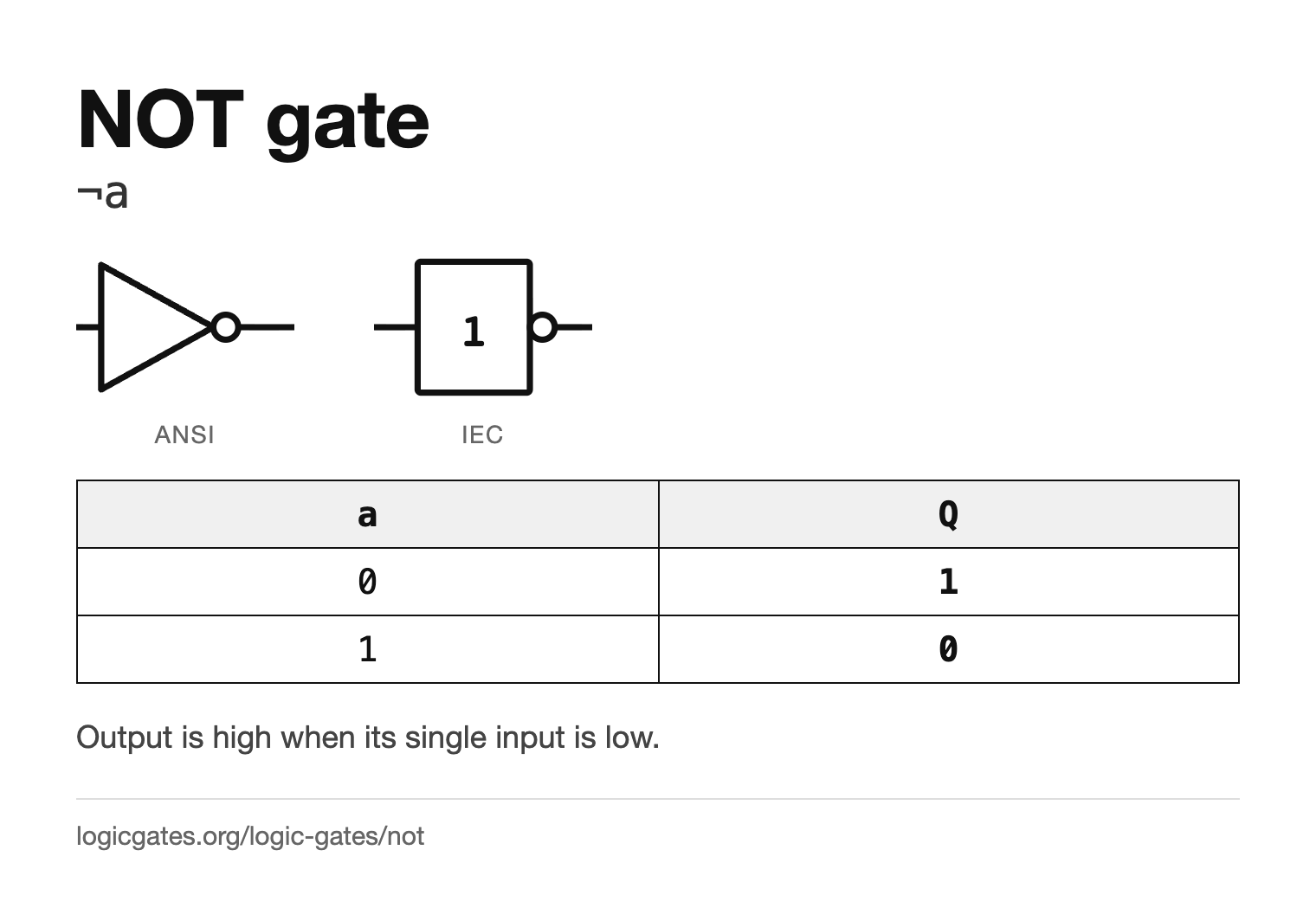 Click to download the NOT reference card
Where the NOT gate is used
- Turning an active-low signal into an active-high one, which is most of what inverters do in real boards.
- Completing a set: AND and OR alone cannot express everything, but add NOT and you can express any boolean function at all.
- Building a ring oscillator, where an odd number of inverters in a loop never settles and oscillates instead.
- Producing the complement of a variable for a sum of products expression.
In the simulator
NOT is in the Logic menu. It is the one gate with a fixed single input, so there is no input count to set.
Questions about the NOT gate
Why is a NOT gate called an inverter?
Because it inverts its input: the output is always the opposite level. The two names mean the same thing, and in circuit diagrams it is drawn as a triangle with a small bubble on the output, the bubble being the part that means inversion.
What happens if I chain two NOT gates?
You get the original signal back, since inverting twice cancels out. It is not useless though: a pair of inverters is often used as a buffer, to strengthen a weak signal or to add a deliberate delay.